
Sleep Loss Is a Global Epidemic. Brain Health Starts at Night.
Sleep loss is a population-level brain health issue, not a discipline problem. Why the sleeping brain is where recovery happens, and how to build a repeatable recovery rhythm.
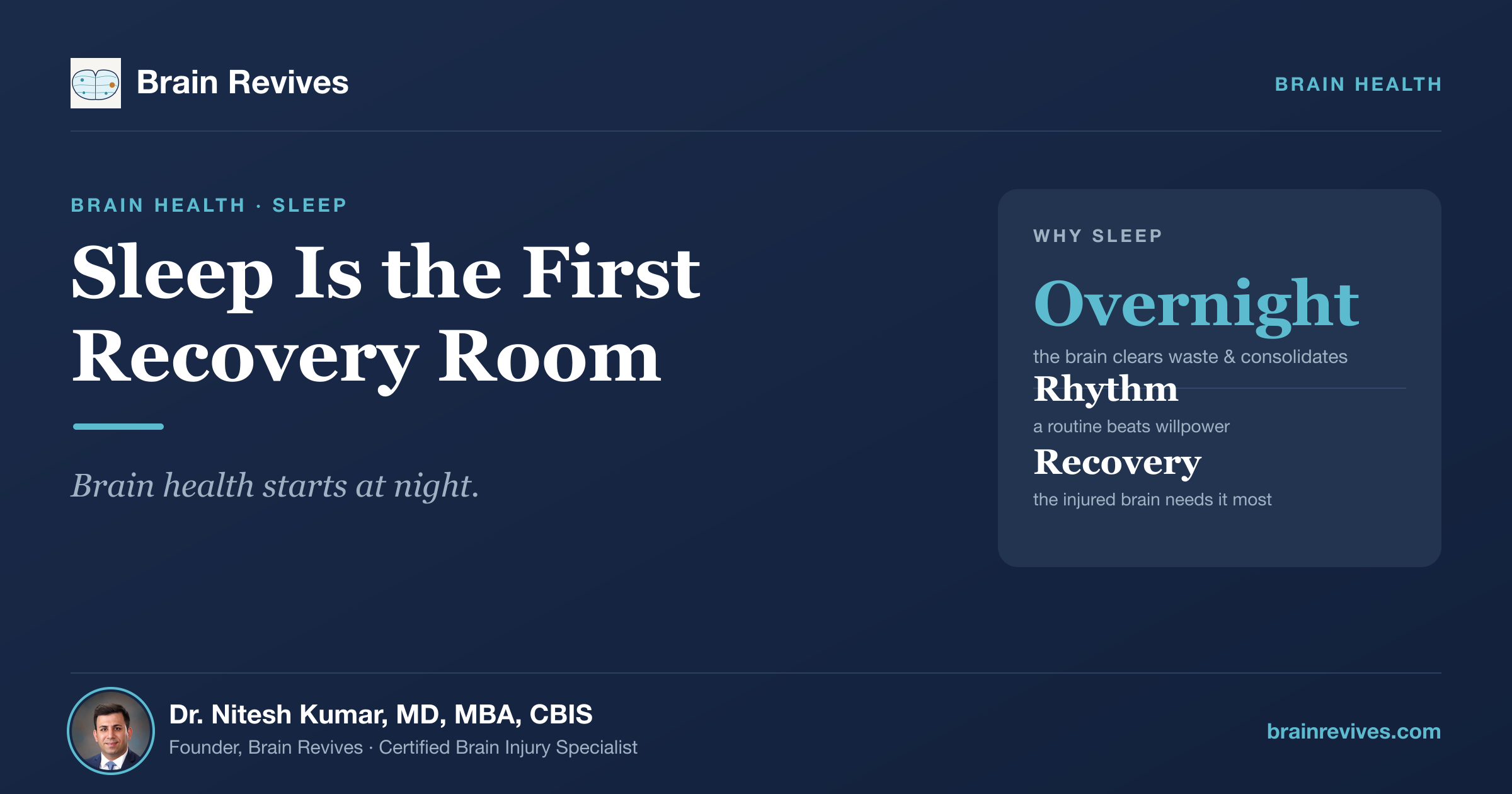
Sleep loss is no longer a private inconvenience. It is a global public health problem hiding in plain sight.
Modern life is built against sleep. Screens extend the day. Work follows people home. Caregivers sleep with one ear open. Patients recovering from brain injury may nap during the day, lie awake at night, wake repeatedly, or feel exhausted even after enough hours in bed. Shift workers fight biology for a paycheck. Parents trade sleep for survival. Students and professionals still wear exhaustion like proof of discipline.
The brain does not experience sleep loss as discipline.
It experiences it as stress.
The Centers for Disease Control and Prevention defines short sleep in adults as less than 7 hours in a 24-hour period. In 2022, the percentage of U.S. adults reporting insufficient sleep varied widely by state, from 30% to 46%. That is not a small wellness problem. It is a population-level brain health issue.
Globally, the same pattern shows up through industrialized 24-hour work, artificial light, psychosocial stress, alcohol use, electronic media, and reduced physical activity. A RAND analysis of five OECD countries estimated that insufficient sleep can carry major economic costs through lost productivity, absenteeism, presenteeism, and mortality risk. The language of “sleep loss” sounds personal. The consequences are societal.
But the most important cost may be inside the nervous system.
Sleep is not shutdown
Sleep is often described as rest. That word is too passive.
During sleep, the brain is active, organized, and biologically busy. The National Institute of Neurological Disorders and Stroke describes sleep as essential for forming and maintaining the brain pathways that support learning and memory. Sleep also affects attention, reaction time, mood, metabolism, immune function, cardiovascular health, and disease resistance.
In other words, sleep is not time away from recovery.
Sleep is recovery.The sleeping brain cycles through non-REM and REM sleep. Deep non-REM sleep helps the body settle into its lowest heart rate and breathing levels of the night. REM sleep, which tends to become longer later in the night, is tied to dreaming, emotional processing, and memory consolidation. Memory consolidation appears to require both non-REM and REM sleep.
That matters for anyone trying to heal, learn, or rebuild function.
If the brain is recovering from concussion, traumatic brain injury, stroke, chronic stress, depression, pain, or prolonged overload, sleep is not optional background support. It is part of the treatment environment.
What sleep loss does to the brain
Sleep loss affects the brain in several overlapping ways.
First, it weakens attention. People who are sleep deprived are more likely to drift, miss details, react slowly, and make errors. This is not just “being tired.” It is impaired information processing.
Second, it disrupts memory. The brain needs sleep to stabilize and organize what was learned during the day. Poor sleep makes it harder to encode new information, retrieve what matters, and use memory flexibly.
Third, it alters emotional regulation. Sleep loss makes the nervous system more reactive. Frustration rises faster. Anxiety can feel louder. Depression can deepen. For a patient recovering from brain injury, this can be misread as poor motivation, irritability, or personality change when sleep may be one of the drivers.
Fourth, it increases physiologic strain. Chronic short sleep is associated with higher risk of hypertension, diabetes, heart disease, stroke, depression, obesity, and premature mortality. These are not separate from brain health. Vascular health, metabolic health, immune health, and brain health travel together.
Fifth, sleep loss may interfere with the brain’s housekeeping systems. Research on the glymphatic system suggests that sleep is linked to cerebrospinal fluid movement and clearance of metabolic waste products from brain tissue. The human research is still developing, and this should not be oversold as a simple “detox” claim. But the direction is important: the sleeping brain appears to use the night for maintenance that wakefulness does not fully replace.
The cellular recovery problem
“Cellular regeneration” is a phrase that needs care.
Sleep does not guarantee brain-cell regrowth. It does not reverse neurological injury on command. It is not a cure for traumatic brain injury, stroke, dementia, depression, or chronic illness.
But sleep does support the biology that cells depend on.
Healthy sleep helps regulate inflammation, immune function, glucose metabolism, hormone rhythms, autonomic balance, protein handling, and tissue repair. These systems shape the environment in which neurons, glial cells, blood vessels, synapses, and peripheral tissues function.
For brain health, the goal is not to chase a miracle regeneration claim.
The goal is to create a recovery environment.
A recovery environment gives cells the best available conditions to repair, communicate, adapt, and conserve energy. Poor sleep does the opposite. It raises the biological cost of being awake. It makes the brain work harder to do less. It narrows cognitive bandwidth. It can turn normal rehabilitation into a push-crash cycle.
That is why sleep has to be treated as infrastructure.
Why this matters after brain injury
Sleep disturbance is common after traumatic brain injury. Reviews estimate that a substantial portion of people with TBI experience insomnia, hypersomnia, circadian rhythm disruption, sleep apnea, or other sleep-wake problems. One meta-analysis reported that about half of people experience some form of sleep disturbance after TBI, with diagnosed sleep disorders far more common than in the general population.
This matters because sleep problems can prolong recovery and worsen the very symptoms families are trying to solve:
- Brain fog
- Headache
- Mood instability
- Poor attention
- Low stamina
- Dizziness tolerance
- Reduced independence in daily activities
- Lower participation in therapy
- Caregiver strain
For Brain Revives, this is central.
A patient may say, “I cannot think.”
A caregiver may say, “He is not trying.”
A clinician may see slow progress.
But the real bottleneck may be sleep.
If the brain is not getting consolidated, predictable, restorative sleep, the rest of recovery becomes less efficient. Cognitive work feels harder. Emotional regulation gets thinner. Activity tolerance shrinks. The patient pushes on a good day, crashes the next day, sleeps at the wrong time, then repeats the cycle.
That is not failure.
It is a system problem.
The Brain Revives view
Brain Revives treats sleep as one of the foundations of recovery after brain injury, stroke, and concussion.
Not because sleep fixes everything.
Because sleep affects everything.
The recovery question is not only, “How many hours did you sleep?”
The better questions are:
- Did you wake at a consistent time?
- Did your sleep feel refreshing?
- Did you wake repeatedly?
- Are you sleeping too much during the day because nighttime sleep is broken?
- Are headaches, pain, anxiety, medications, caffeine, alcohol, screens, or sleep apnea interfering?
- Is the caregiver’s sleep also collapsing?
- Does the daily activity plan protect sleep, or does it sabotage it?
For patients and caregivers, sleep becomes a clinical signal. It helps explain why symptoms rise, why progress stalls, and why a plan that looked reasonable on paper may be too much for the current nervous system.
How to optimize sleep for brain recovery
The goal is not a perfect night. The goal is a repeatable recovery rhythm.
How to protect your sleep
- 1
Anchor the wake time
Choose a consistent wake time and keep it steady, including weekends, to give the circadian system a reliable anchor. Bedtime can move gradually based on sleepiness, but wake time should be protected. For brain injury patients, adjust slowly so the schedule is steady enough to train the body clock without causing a crash.
- 2
Get morning light
The circadian clock responds strongly to light. Get outside early, even briefly, or sit near bright natural light if going out is not possible. Keep evenings dimmer to support nighttime sleep pressure later.
- 3
Make the bedroom boring, dark, quiet, and cool
The bedroom should tell the nervous system one message: sleep happens here. Reduce screens, work materials, news, bright light, and activating content. If the patient is noise-sensitive after brain injury, consider soft earplugs, white noise, or a fan if tolerated.
- 4
Protect the last 30 to 60 minutes
Give the brain a landing pattern. In the final hour, dim lights, stop work, and avoid arguments, medical research spirals, intense exercise, and symptom checking. Use the same sequence most nights: hygiene, medication review if prescribed, light stretching or breathing, quiet reading, lights out.
- 5
Manage caffeine, alcohol, and heavy meals
Caffeine can interfere with sleep long after the last cup, so move it earlier. Alcohol may ease sleep onset but can fragment sleep and worsen breathing, so keep it away from recovery sleep when possible. Avoid large meals close to bedtime.
- 6
Use naps carefully
Naps can help recovery, especially early after brain injury, but long or late naps weaken nighttime sleep. A brief planned rest period works better than accidental long daytime sleep. If daytime sleep is unavoidable, track its timing and duration.
- 7
Treat pain, headache, mood, and breathing as sleep issues
Pain, post-traumatic headache, depression, anxiety, PTSD, medication side effects, nocturia, restless legs, and sleep apnea can all fragment sleep. A patient who wakes unrefreshed, snores loudly, gasps at night, has morning headaches, or has severe daytime sleepiness should discuss sleep apnea or another sleep disorder with a clinician. Do not moralize a medical bottleneck. Identify it.
- 8
Track sleep next to symptoms
A sleep diary can be simple: bedtime, wake time, night wakings, nap timing, caffeine and alcohol timing, morning energy, and main symptoms the next day. After one to two weeks, patterns usually become visible. The goal is not surveillance, it is better decisions.
1. Anchor the wake time
The most practical place to start is the morning.
Choose a consistent wake time and keep it as steady as possible, including weekends. This gives the circadian system a reliable anchor. Bedtime can move gradually based on sleepiness, but wake time should be protected.
For brain injury patients, this may need to be adjusted slowly. A rigid schedule that causes a crash is not the goal. The goal is steady enough to train the body clock.
2. Get morning light
The brain’s circadian clock responds strongly to light. Morning light helps set the day-night rhythm and supports nighttime sleep pressure later.
Practical version: get outside early, even briefly. If that is not possible, sit near bright natural light. Keep evenings dimmer.
3. Make the bedroom boring, dark, quiet, and cool
The bedroom should tell the nervous system one message: sleep happens here.
Keep the room dark, quiet, relaxing, and cool. Remove or reduce screens, work materials, news, bright light, and emotionally activating content. If the patient is noise-sensitive after brain injury, consider soft earplugs, white noise, or a fan if tolerated.
4. Protect the last 30 to 60 minutes
The brain needs a landing pattern.
The final hour before bed should reduce input. Dim lights. Stop work. Avoid arguments, medical research spirals, intense exercise, and symptom checking. Use the same sequence most nights: hygiene, medication review if prescribed, light stretching or breathing, quiet reading, lights out.
This is not about aesthetics. It is conditioning.
5. Manage caffeine, alcohol, and heavy meals
Caffeine can interfere with sleep long after the last cup. For many people, afternoon caffeine is too late. Alcohol may make sleep onset easier but can fragment sleep and worsen breathing problems. Heavy meals close to bedtime can also disrupt sleep.
The simple rule: move caffeine earlier, keep alcohol away from recovery sleep when possible, and avoid large meals close to bed.
6. Use naps carefully
Naps can help recovery, especially early after brain injury. But long or late naps can weaken nighttime sleep.
For many patients, a brief planned rest period works better than accidental long daytime sleep. If daytime sleep is unavoidable, track timing and duration. The pattern matters.
7. Treat pain, headache, mood, and breathing as sleep issues
Poor sleep is not always a discipline problem.
Pain, post-traumatic headache, depression, anxiety, PTSD, medication side effects, nocturia, restless legs, and sleep apnea can all fragment sleep. A patient who wakes unrefreshed, snores loudly, gasps at night, has morning headaches, or has severe daytime sleepiness should discuss sleep apnea or another sleep disorder with a clinician.
In Brain Revives language: do not moralize a medical bottleneck.
Identify it.
8. Track sleep next to symptoms
A sleep diary does not need to be complicated.
Track:
- Bedtime
- Wake time
- Night wakings
- Nap timing
- Caffeine and alcohol timing
- Morning energy
- Main symptoms the next day
After one to two weeks, patterns usually become visible. The goal is not surveillance. The goal is better decisions.
What good sleep makes possible
Good sleep does not guarantee recovery. But it improves the conditions for recovery.
It gives the brain a better chance to consolidate learning from therapy. It supports emotional steadiness. It helps regulate inflammation and metabolism. It reduces the likelihood that every cognitive task becomes a high-effort task. It helps the patient and caregiver see what is actually improving.
When sleep improves, the recovery plan often becomes clearer.
The patient may still need rehabilitation, medical evaluation, medication review, mental health support, sleep medicine, vestibular therapy, neuropsychology, or coordinated care. Sleep does not replace those.
But sleep can make them work better.
That is the point.
The global sleep loss epidemic is not just about tired people. It is about brains being asked to heal, learn, decide, regulate emotion, clear waste, coordinate movement, and return to daily life without the biological conditions required to do that work.
For Brain Revives, sleep is not a side topic.
It is the first recovery room.
References
- CDC. FastStats: Sleep in Adults.
- CDC. About Sleep.
- National Institute of Neurological Disorders and Stroke. Brain Basics: Understanding Sleep.
- Watson NF, Badr MS, Belenky G, et al. Recommended Amount of Sleep for a Healthy Adult: A Joint Consensus Statement of the American Academy of Sleep Medicine and Sleep Research Society. Sleep. 2015.
- Hafner M, Stepanek M, Taylor J, Troxel WM, van Stolk C. Why Sleep Matters: The Economic Costs of Insufficient Sleep. RAND Health Quarterly. 2017.
- Hablitz LM, Nedergaard M. Sleep, Cerebrospinal Fluid, and the Glymphatic System: A Systematic Review. Clocks & Sleep. 2021.
- Zuzuárregui JRP, Bickart K, Kutscher SJ. A Review of Sleep Disturbances Following Traumatic Brain Injury. Sleep Science and Practice. 2018.
- Mollayeva T, et al. Prevalence of Sleep Disturbances, Disorders, and Problems Following Traumatic Brain Injury: A Meta-Analysis. Sleep Medicine. 2013.
- Zielinski MR, et al. Sleep Loss as a Factor to Induce Cellular and Molecular Inflammatory Variations. Clinical and Developmental Immunology. 2013.
Brain Revives provides educational recovery support and is not a substitute for medical care, diagnosis, treatment, therapy, emergency care, or physician-directed advice. If this is an emergency, call 911 or go to the nearest emergency department.