
Recovery Doesn't Have a Deadline: What 20 Years of Brain Injury Data Actually Show
Twenty years of data on 14,000+ brain injury survivors show recovery behaves like a chronic condition, not a plateau. Why the 'window has closed' myth is wrong.
She came to me with a sentence someone in a white coat had handed her a year earlier, and she had been carrying it like a verdict.
“They told us this is his new normal. Whatever he has back by now is what he keeps.”
Her husband was fourteen months out from a severe brain injury. He had made real gains in the first year, then the visits got shorter and further apart, and the message underneath all of them was the same. The window is closing. Set your expectations. This is the plateau.
I understand why families hear that. I understand why some clinicians say it. But it does not match what the long-term data actually show, and I have watched that single sentence quietly end recoveries that were not finished.
I want to correct the record here.
The number that changes the story
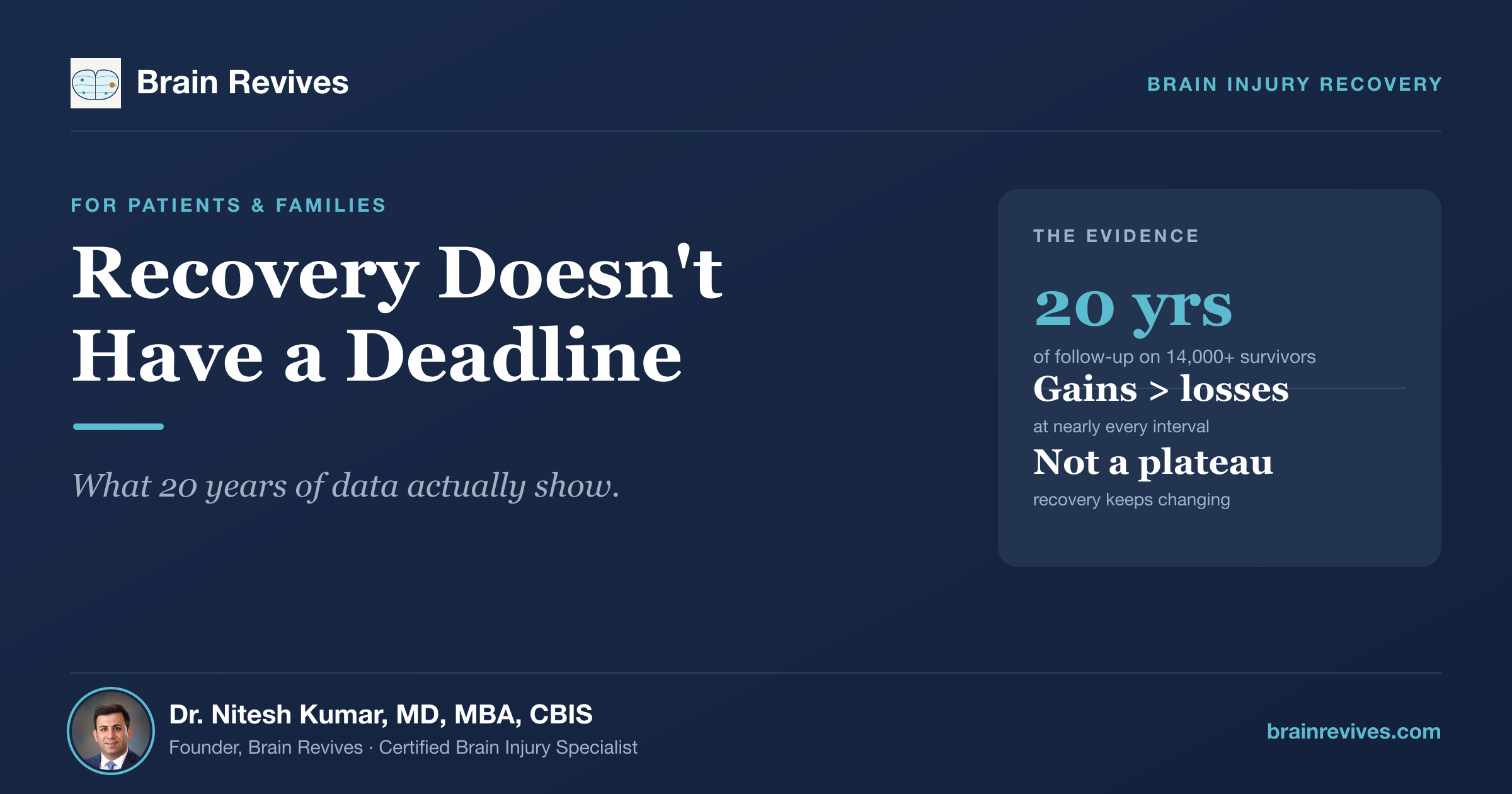
Researchers followed more than 14,000 brain injury survivors and tracked their outcomes at 1, 2, 5, 10, 15, and 20 years after injury. This is one of the largest and longest windows we have into what really happens to people over the arc of a life after brain injury.
Illustrative of the study's core finding, improvement outnumbered decline at nearly every interval. Not exact study values.
Here is the finding that almost no family is ever told. When you look at how people changed from one checkpoint to the next, improvement was more common than decline in every interval except the first year to the second. In most stretches, fewer than half of survivors stayed exactly the same. People kept moving. And more of them moved forward than backward, years and even decades out.
Brain injury, the researchers concluded, behaves less like a one-time event with a fixed ending and more like a chronic condition that keeps changing. Dynamic, not stable. That is the opposite of a plateau.
Why the “window” myth persists
The myth is not made up out of nothing. It grows out of a real pattern, misread.
The fastest, most visible gains usually do come early, in the first months and the first couple of years. If you only measure the slope of the curve at the very beginning, it looks like everything important happens up front and then stops. So the system builds its calendar around that assumption. Follow-ups thin out. Therapy authorizations run out. The plan, if there was one, expires.
But “the fast part is over” is not the same as “the recovery is over.” When the visible sprint ends, a slower, quieter process continues underneath. The brain keeps reorganizing. Skills keep consolidating with practice. People keep adapting to their world and rebuilding a life inside it. The data pick that up clearly. The calendar most families are given does not.
There is a second, harder truth in the same research, and I will not hide it. For some survivors, especially those injured at older ages, function can decline in the later years, and aging and other health conditions start to matter more than the original injury. That is not an argument for giving up. It is the strongest argument there is for staying engaged. The trajectory is not fixed, which means it responds to what you do, in both directions. A recovery that is supported keeps its gains longer and reaches further than one that is abandoned at month twelve.
What “no deadline” does not mean
Let me be the honest one here, because false hope is its own kind of harm.
No deadline does not mean everyone returns to exactly who they were. It does not mean effort alone erases a severe injury. Where someone stands at year one still shapes the range of what comes next, and I would never tell a family otherwise.
What it means is this. The door your care team implied was closing is not, in fact, closing on schedule. The story that the first year decides everything is not supported by twenty years of evidence. And “this is your new normal, so stop expecting more” is a sentence about a system’s timeline, not about your brain’s biology.
What actually helps over the long arc
If recovery is a long process rather than a short window, then the thing that matters most is not intensity for a few months. It is continuity.
Keep a structure in place after the formal rehab ends, when most families are handed nothing at all. Keep setting real, specific goals for daily life, because the gains in the later years tend to come from practice and adaptation, not from a scan looking different. Protect the things that guard the brain over decades, sleep, mood, activity, connection, because in the long run those often shape the trajectory more than the original injury did. And do not let a calendar you did not choose decide when you are done.
This is exactly the gap Brain Revives was built for. Not the acute emergency, which the hospital handles well, but the long stretch afterward where the appointments disappear and the family is left to figure it out alone. That stretch is not the leftover part of recovery. The data say it may be most of it.
If someone told you the window is closed
If you are caring for someone and you were handed that sentence, the plateau, the new normal, the window has closed, I want you to hold it a little more loosely. Twenty years of data on more than 14,000 survivors say the picture is more open, and more hopeful, than a fifteen-minute follow-up visit can capture.
Brain Revives is a 12-week, specialist-led education program built for the long arc of recovery, the part after discharge that the system tends to forget. The introductory session is free. No cost, no commitment, just a clearer, more accurate picture of what is still possible and how to protect it.
And if someone you know has been told their recovery is finished, send them this. It might reopen a door they were told to stop knocking on.
Brain Revives provides educational recovery support and is not a substitute for medical care, diagnosis, treatment, therapy, emergency care, or physician-directed advice. If this is an emergency, call 911 or go to the nearest emergency department.