You Can Rebuild Thinking Skills: The Brain Injury Treatment Families Are Rarely Told About
There is a huge body of evidence for rebuilding attention, memory, and daily thinking after brain injury. Most families never hear about it. Here is what helps.
The daughter had done her research, and she was angry in the quiet, careful way people get when they feel they have been let down by the system.
“For a year everyone told us to just be patient. That his memory and focus were what they were, and we should adjust our expectations. Then I read that there’s an actual treatment for this, with real evidence behind it. Nobody ever mentioned it. Why?”
It is a fair question, and it deserves an honest answer. There is a large, serious body of evidence for helping people rebuild attention, memory, and everyday thinking after a brain injury. Most families never hear about it. The problem is not that the treatment does not exist. The problem is that it rarely reaches the people who need it.
I want to change that, starting with you.
The evidence is not thin. It’s enormous.
When you cannot remember appointments, lose your keys and your train of thought a dozen times a day, or cannot organize the steps of a task you used to do without thinking, it is easy to believe nothing can be done. That belief is understandable, and it is wrong.
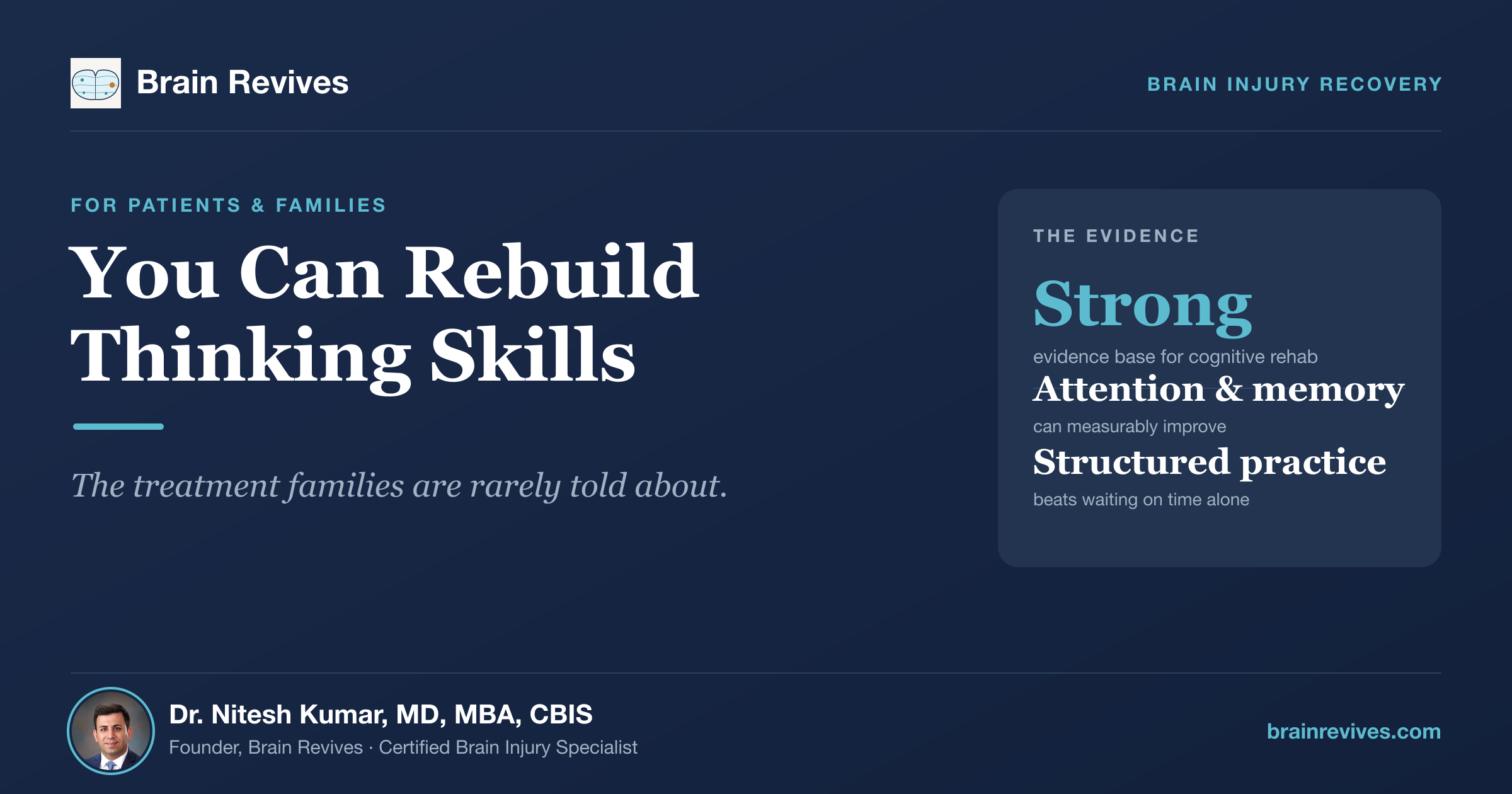
There is a field called cognitive rehabilitation devoted precisely to these problems, and it rests on hundreds of clinical trials. An international panel of researchers and clinicians reviewed that evidence and distilled it into a set of formal, graded best-practice guidelines, 80 specific recommendations covering attention, memory, executive function, and communication. These are not hopeful ideas. They are evidence-based methods, rated by how strong the proof behind each one is.
Read that daughter’s question again with that in mind. This was never a case of “there is nothing to offer.” It was a case of a proven approach not making it from the research into her father’s living room.
Why proven treatment doesn’t reach families
If the evidence is this strong, why is the silence so common? A few honest reasons.
The system is built for the emergency, not the aftermath. Hospitals are extraordinary at the acute phase, the surgery, the stabilization, the survival. The long, slow work of rebuilding cognition happens months later, after discharge, in a part of the journey that has far less infrastructure and far fewer people whose job it is to guide you.
Good research is slow to become common practice. There is a well-known lag between what the best evidence shows and what routinely happens in everyday care. The guidelines themselves exist largely because that gap is real and stubborn. A treatment can be well-proven and still be unevenly delivered.
The problems are invisible, so they get under-treated. A memory or attention deficit does not show on a scan or a cast. It is easy for a busy system to under-recognize what it cannot see, and to default to “give it time” instead of “here is a structured plan.”
None of that is a conspiracy. It is a gap. But a gap is exactly the kind of thing that can be closed, once a family knows it is there.
What rebuilding thinking skills actually looks like
This is not brain-training games or willpower. Done well, cognitive rehabilitation is structured, specific, and practical. It works in two complementary ways.
One is teaching the brain to do more, through targeted, repeated practice of the specific skills that were hurt, so the underlying ability strengthens over time. The other is building smart external systems and strategies, the calendars, checklists, routines, and step-by-step methods that carry the load while the brain recovers, so daily life works now, not just eventually. The best programs do both, and they aim the work at the tasks that actually matter in a person’s real life, not abstract exercises.
The honest caveat belongs here too. This is not a cure, and it does not erase a serious injury. What the evidence supports is meaningful, measurable improvement in function and independence, the difference between a person who is lost inside their own day and one who has tools that make the day work. For a family living this, that difference is not small. It is close to everything.
What actually helps
Know that these problems are treatable, because that belief is the door everything else walks through. Ask directly whether cognitive rehabilitation strategies are part of the plan, and do not accept “just be patient” as a complete answer. Put structure and external systems in place now, since they help immediately while recovery continues underneath. And focus the effort on the real tasks of the person’s actual life, because that is where the evidence says the gains take hold.
Approaches that actually help
- 1
Know it is treatable
Start from the belief that these problems can improve, because that belief is the door everything else walks through.
- 2
Ask directly about the plan
Ask whether cognitive rehabilitation strategies are part of the plan, and do not accept “just be patient” as a complete answer.
- 3
Put structure in place now
Set up external systems today, since they help immediately while recovery continues underneath.
- 4
Focus on real-life tasks
Aim the effort at the real tasks of the person's actual life, because that is where the evidence says the gains take hold.
This is the heart of what we do at Brain Revives. We take the kind of structured, evidence-based approach that too often stays locked in a rehab hospital or a research paper, and we put it into the hands of the survivor and the family, in plain language, during the exact stretch after discharge when almost no one else is walking beside them.
If you were told to just be patient
If someone you love is struggling with memory, focus, or organizing daily life after a brain injury, and the guidance you got was essentially to wait and lower your expectations, I want you to know there is more available than you were told. The evidence for rebuilding these skills is deep. It just has to reach you.
Brain Revives is a 12-week, specialist-led education program built to close that exact gap, between the proven approaches that exist and the family standing in the kitchen wondering if anything can be done. The introductory session is free. No cost, no commitment, just a clear look at what is actually possible and how to start.
👉 brainrevives.com/register
And if you know a family that was handed silence where a plan should have been, share this with them. The first step is simply knowing the treatment exists.
Brain Revives provides educational recovery support and is not a substitute for medical care, diagnosis, treatment, therapy, emergency care, or physician-directed advice. If this is an emergency, call 911 or go to the nearest emergency department.