It's Not Him. It's the Injury: Understanding Anger and Agitation After Brain Injury
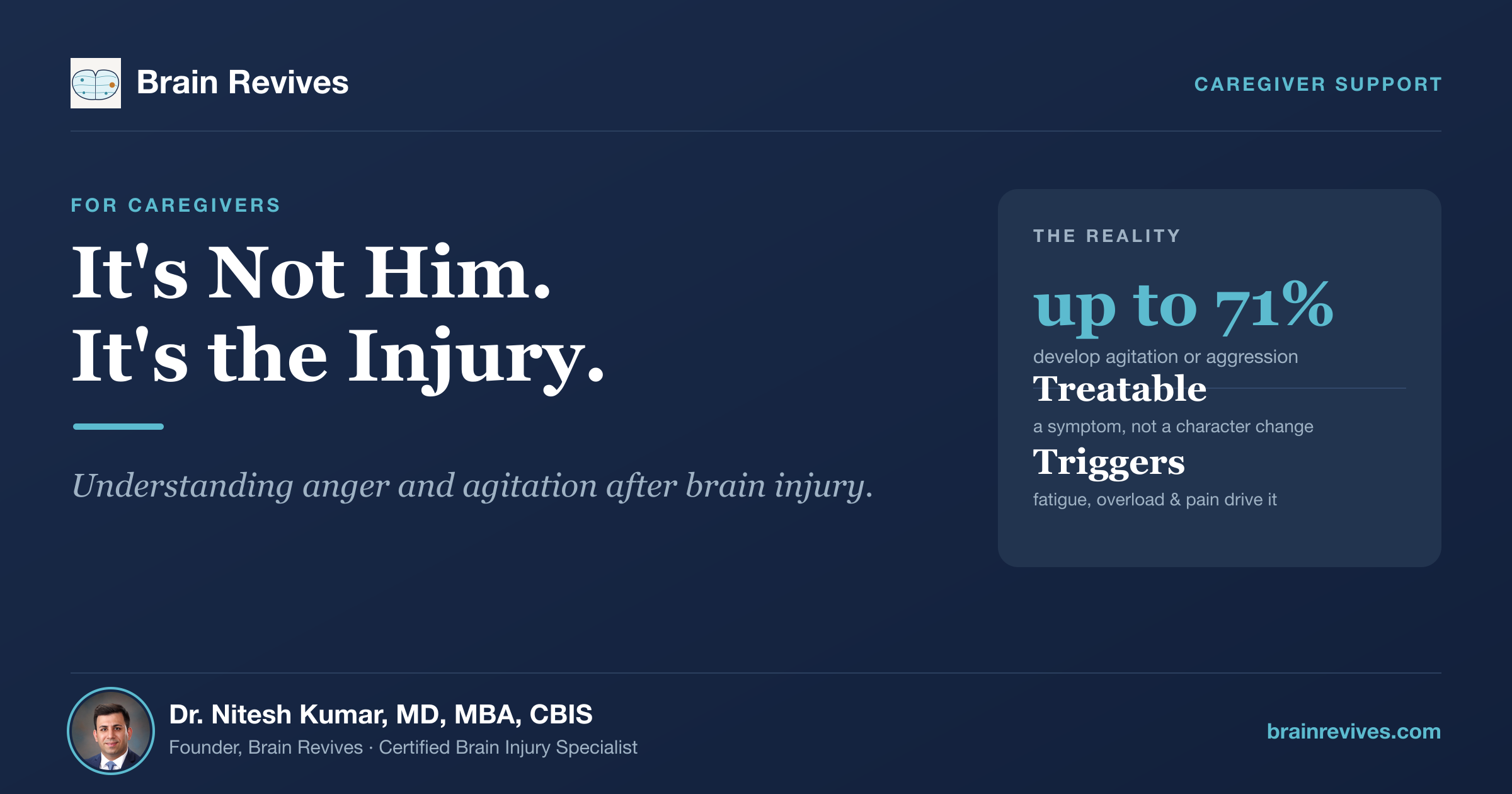
Up to 71% of brain injury survivors develop agitation or aggression in recovery. It is a treatable symptom, not a change of character. Here is why, and what helps.
The wife said the sentence quietly, the way people say the things they feel guilty for thinking.
“I don’t know this man anymore. He was the gentlest person I ever met, and now he snaps at everyone. Sometimes I’m a little afraid of him.”
Her husband had a moderate brain injury four months earlier. He was yelling at the grandkids over noise he used to laugh at. He got up mid-dinner and slammed a door for no reason anyone could see. She had started to grieve the person she married, while he was still sitting in the next room.
I told her what I want to tell you. What she was describing was not a change in who he was. It was one of the most common medical symptoms after a brain injury, and it has causes, and it can be managed. Nobody had explained that to her, so she had done the natural thing. She had blamed the person instead of the injury.
How common this really is
This is not a rare, unlucky reaction. In the research on brain injury rehabilitation, up to 71 percent of patients develop agitation or aggression during their recovery. In acute care settings the figure runs up to about 41 percent. Put plainly, irritability, a short fuse, sudden anger, restlessness, and outbursts are among the expected consequences of a brain injury, not a sign of a ruined character.
Families are almost never told this number. So when it shows up at home, they have no framework for it, and the only explanation left is the cruelest and least accurate one. He changed. He got mean. This is who he is now.
Why a healing brain gets a short fuse
The behavior is not coming from nowhere, and it is not aimed at the family the way it feels like it is. A few things are happening under the surface.
The brake pads are worn. A brain injury often damages the exact systems that regulate impulse and emotion, the front-of-brain machinery that lets us feel a surge of frustration and not act on it. The feeling still arrives at full strength. The part that used to catch it before it became a slammed door is slower, or briefly offline. That is not a choice. It is an injury to the very system that would normally make the other choice.
The world is turned up too loud. After an injury, the brain loses some of its ability to filter noise, light, crowds, and competing demands. What feels like a normal, pleasant family dinner to everyone else can feel, inside an injured brain, like standing in the middle of a construction site. Agitation is often the overflow of a nervous system that is being flooded and cannot turn the volume down.
Something physical is frequently driving it. This is the part clinicians hold onto, because it is the most fixable. Agitation and aggression after brain injury are very often the visible edge of something treatable underneath. Untreated pain. A brewing infection. A medication side effect. Poor sleep. Constipation, hunger, or a bladder problem in someone who can no longer tell you what hurts. In brain injury care, a sudden behavior change is treated as a signal to go looking for a cause, not as a personality to be endured.
Put those together and the outburst stops looking like malice and starts looking like what it is. A stressed, injured, possibly hurting brain, overwhelmed, with a weakened brake.
The reframe that changes the house
When a family believes “he became an angry person,” every outburst is evidence of loss, and the home fills up with grief and fear. When a family understands “his injured brain is overwhelmed and something may be driving it,” every outburst becomes a question. What set this off? Was it too loud, too fast, too much? Is he in pain? Is he tired? Did the pattern change, and if so, what changed with it?
That shift does two things at once. It gives the survivor back their dignity, because they are no longer being treated as someone who went bad. And it hands the family a job they can actually do, because now there is something to look for and adjust, instead of a person to be afraid of.
I have watched that reframe lower the temperature of an entire household in a week. Nothing about the injury changed. The story did.
A note on medication, so you can ask better questions
Sometimes medication is part of managing agitation, and that is a decision for the treating clinician. But families deserve to know one thing, so they can be good advocates. The evidence specifically cautions against reaching first for certain sedating drugs, benzodiazepines and the older antipsychotic haloperidol, because in the setting of a brain injury they can actually work against recovery. There are better-studied options when scheduled treatment is truly needed. You do not have to know the pharmacology. You just have to know it is fair to ask, “is this the safest choice for a brain injury specifically, and have we ruled out pain, infection, and sleep first?”
What actually helps
Look for the trigger before you manage the behavior. Lower the load, one loud, bright, crowded room at a time. Protect sleep, treat pain, and take a new or worsening behavior seriously as a possible sign of something physical. Keep routines predictable, because predictability is calming to an overwhelmed brain. And bring the whole family into the same understanding, so the survivor is not being quietly judged by the people they most need on their side.
What helps in the moment
- 1
Look for the trigger first
Before you manage the behavior, find what set it off, too loud, too fast, too much.
- 2
Lower the load
Bring down the input one loud, bright, crowded room at a time.
- 3
Protect sleep and treat pain
Take a new or worsening behavior seriously as a possible sign of something physical.
- 4
Keep routines predictable
Predictability is calming to an overwhelmed brain.
- 5
Bring the whole family in
Share one understanding so the survivor is not being quietly judged by the people they most need.
This is one of the first things we work through with families at Brain Revives, because behavior is where so many households quietly break apart after an injury, and it is one of the most teachable, most changeable parts of the whole recovery.
If you have started to grieve someone who is still here
If you are caring for someone whose temper or personality seems to have changed, and you have wondered whether the person you love is simply gone, I want you to consider another possibility. You may be watching a common, treatable symptom of the injury, wearing a mask that looks exactly like a change of character.
Brain Revives is a 12-week, specialist-led education program built for exactly this gap, the space between what families are told at discharge and what they actually need to understand to help someone heal, and to stay safe and sane themselves. The introductory session is free. No cost, no commitment, just a clearer picture of what is really happening and what you can do about it.
👉 brainrevives.com/register
And if this would help a family you know, share it. Someone out there is grieving a person who is still in the next room.
Brain Revives provides educational recovery support and is not a substitute for medical care, diagnosis, treatment, therapy, emergency care, or physician-directed advice. If this is an emergency, call 911 or go to the nearest emergency department.