
It Was Just a Concussion: Why the "Invisible Injury" Is So Often Missed
No blackout and a normal scan do not mean nothing happened. A physician explains why concussion is so often missed and what actually helps recovery.
He almost apologized for being in my office.
“I feel like I’m wasting your time. It was just a concussion. I never even blacked out. The scan was normal. But three months later I still can’t hold a thought, I lose words mid-sentence, and I’m exhausted by lunch. My family thinks I’m using it as an excuse.”
He was not wasting my time. He was describing one of the most under-recognized injuries in medicine, and every reason he gave for doubting himself was actually a reason the injury gets missed.
Let me take those reasons apart one at a time.
”I never blacked out”
Most people believe a real brain injury means getting knocked out cold. It does not.
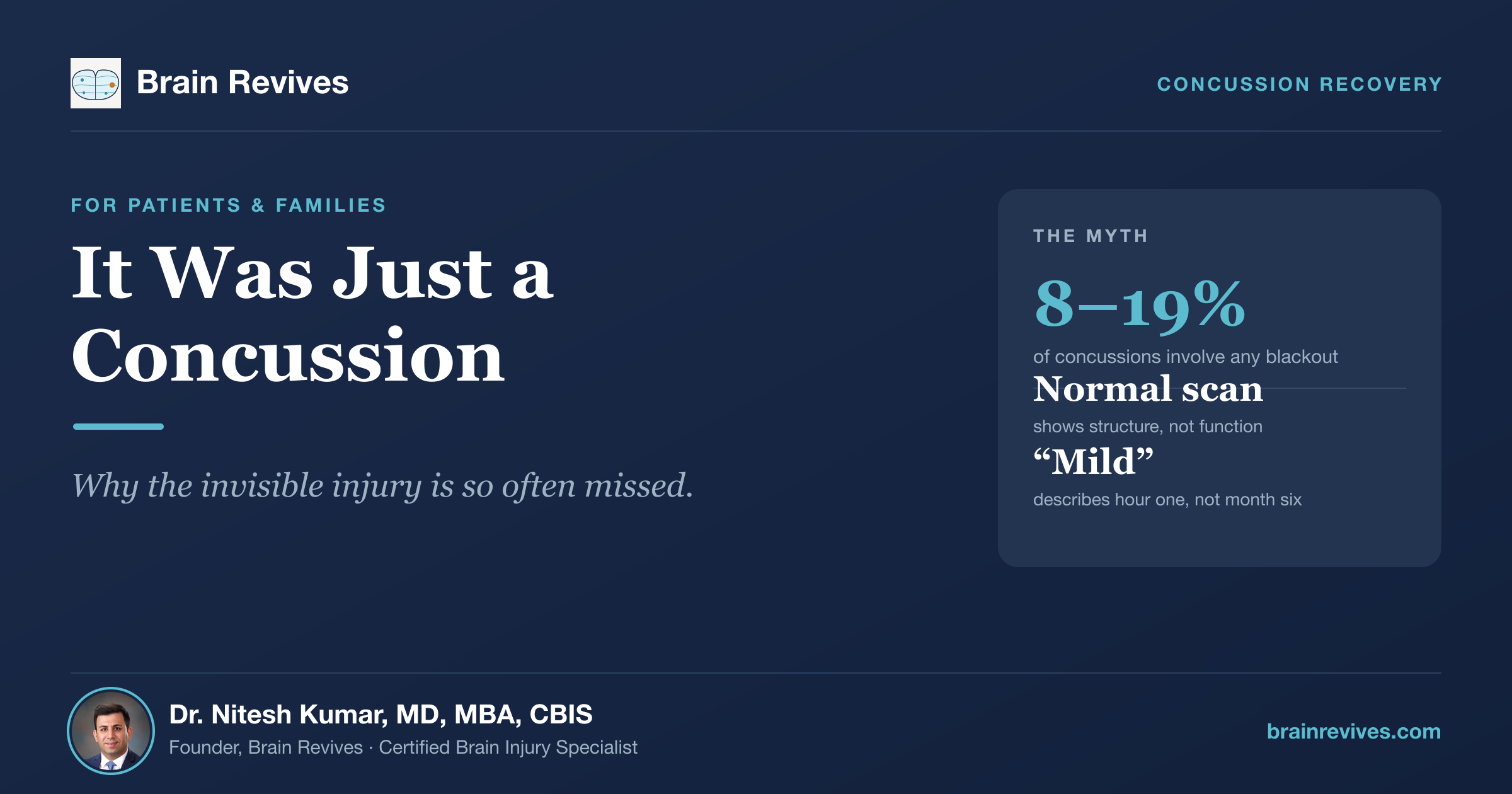
The overwhelming majority of concussions involve no loss of consciousness at all. In sports-related brain injuries, studies suggest that only somewhere between roughly 8 and 19 percent involve any blackout. So the single sign everyone waits for as proof, the person going limp, is absent in four out of five cases. Waiting for a blackout to take a head injury seriously means missing most of them.
”The scan was normal”
A normal CT or MRI is genuinely reassuring for the emergencies those scans are designed to catch, bleeding, swelling, a skull fracture. That is exactly why they are done, and a clean scan is good news.
But a standard scan is a picture of structure, not of function. A concussion is largely a problem of how the brain is working, the timing and efficiency of signals, not always something that shows up as a visible lesion on a routine image. So “your scan is clean” is true and “nothing is wrong with how your brain is working” is a different claim entirely. Many people leave with the first sentence and hear the second. That gap is where the invisible injury lives.
”It was mild, so it should be nothing”
The word “mild” is a measure of how the injury looked in the first hour. It is not a promise about the months that follow.
Even mild traumatic brain injury, including ordinary concussion, can cause lasting problems with memory, attention, and the ability to do daily tasks and return to work. Some people recover fully in a couple of weeks, and most do. But a meaningful minority carry symptoms for months, and “mild on arrival” tells you very little about which group a given person is in. Mild is not the same as minor.
Why this injury is so easy to dismiss
Brain injury is often called the invisible disability, and the name is exact. The person looks completely fine. There is no cast, no wound, no wheelchair. So when they cannot follow a conversation in a noisy room, lose the thread of a task, or fade by early afternoon, the people around them, and often the person themselves, reach for the explanations that fit a healthy-looking body. He’s distracted. She’s not trying. He’s making excuses. The injury is real, but because no one can see it, its cost is charged to the person’s character instead.
And the scale is not small. Millions of Americans live with long-term disability related to a brain injury, and because so many concussions are never diagnosed, never coded, or never brought to care at all, the true number is certainly higher than any official count. This is not a fringe problem. It is a common one, hiding in plain sight because it does not photograph.
The honest caveat
Let me be clear about what I am not saying. I am not telling every person who bumped their head to expect months of symptoms. Most concussions do resolve, and most people do return to themselves, and fear is not the goal.
What I am saying is narrower and more useful. Do not use “no blackout” and “normal scan” as proof that nothing happened. And if the symptoms are still there weeks later, that is not weakness of character and it is not you inventing a problem. It is a known pattern, it has a name, and it deserves attention rather than apology.
What actually helps
Take persistent symptoms seriously, even after a mild injury and a clean scan, because early understanding changes the course. Learn what your specific symptoms are and what makes them worse, so you can work with your brain instead of against it. Pace the recovery instead of powering through, since pushing past the wall tends to lengthen the whole process. And make sure the people around you understand that invisible does not mean imaginary, because being believed is part of healing.
Most of all, know that “just a concussion” still comes with the right to real answers. The absence of a dramatic injury is not the absence of an injury.
If this sounds like you, or someone doubting themselves
If you or someone you love is months past a head injury, still not right, and quietly wondering whether it is all in their head, I want you to hear this from a physician. It is very likely not in your head in the way you fear. It is in your brain, in a way that is real, common, and worth addressing.
Brain Revives is a 12-week, specialist-led education program built for the gap between what people are told after a head injury and what they actually need to understand to recover, including the many people whose injury was labeled mild and then left unexplained. The introductory session is free. No cost, no commitment, just a clearer picture of what you are dealing with and what comes next.
👉 brainrevives.com/register
And if someone in your life has been brushing off their own symptoms as an excuse, share this with them. It might be the permission they have been waiting for to take it seriously.
Brain Revives provides educational recovery support and is not a substitute for medical care, diagnosis, treatment, therapy, emergency care, or physician-directed advice. If this is an emergency, call 911 or go to the nearest emergency department.