
Fatigue Is Not Laziness: The Most Misunderstood Symptom After Brain Injury
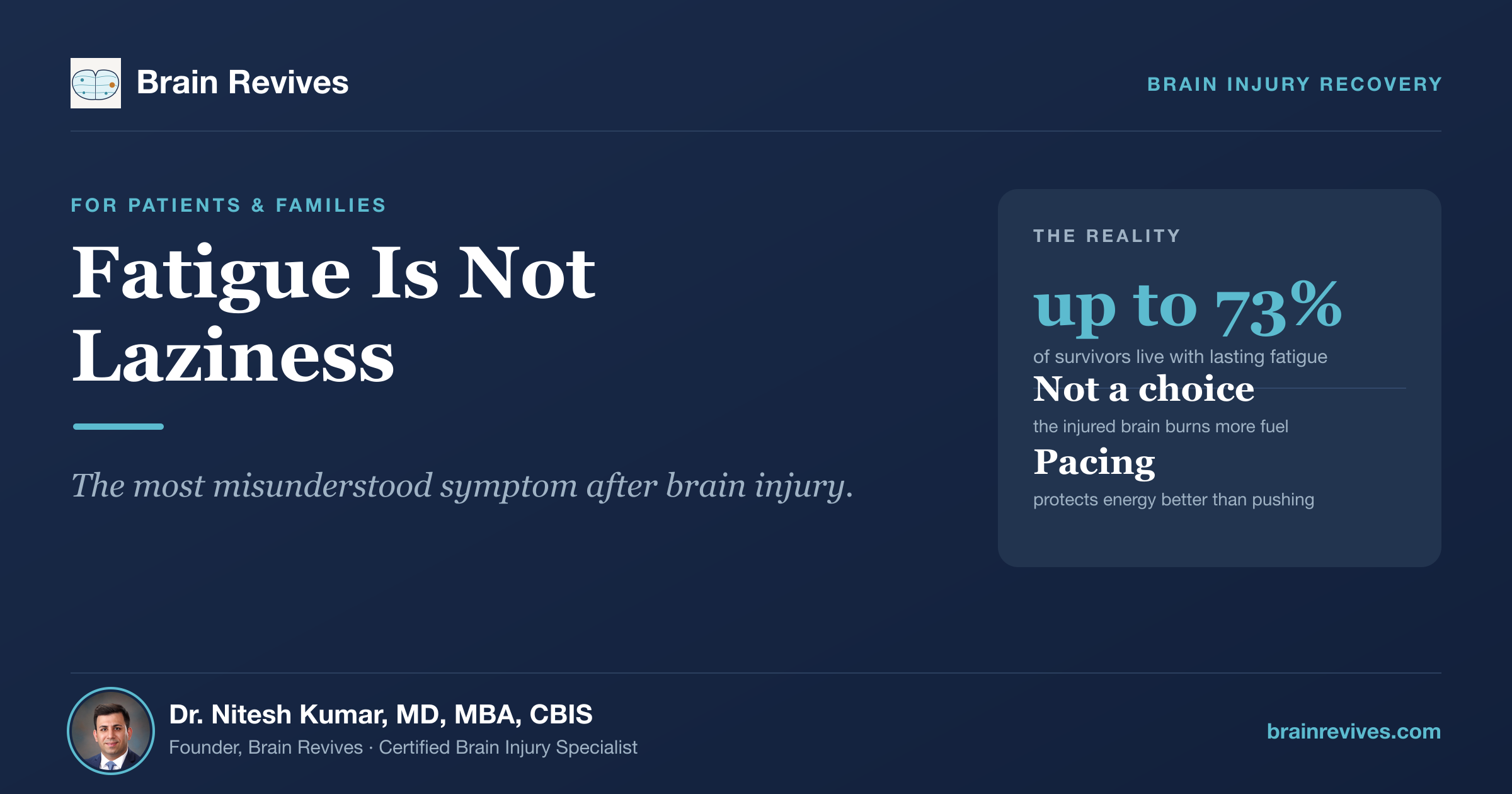
Up to 73% of brain injury survivors live with persistent fatigue. It is physiology, not a character flaw. Here is why a healing brain runs out of fuel and what helps.
The patient was three months out from a moderate traumatic brain injury. He had survived the part everyone worries about. The hospital, the imaging, the early weeks where the question is whether someone makes it. He made it.
And then his family started to lose patience with him.
He slept until ten. He could not get through a full conversation without needing to lie down. He stopped showing up to things he used to love. His brother told me, quietly, in the hallway, that he was worried the man had simply given up. That he was being lazy.
He was not lazy. He was experiencing the single most common and most disabling symptom after a brain injury, and not one person on his care team had explained it to his family in plain language.
I want to fix that here.
The number almost no one hears
Up to 73 percent of brain injury patients live with persistent fatigue. It is the leading cause of long-term disability after a traumatic brain injury. Not the broken bones. Not the early confusion. The fatigue.
It outlasts the visible injuries by months and often years. It is the symptom that keeps people from returning to work, from re-entering their relationships, from rebuilding the life the injury interrupted.
And because it is invisible, it is the symptom most likely to be mistaken for a character flaw.
Why a healing brain runs out of fuel
The mistake families make is an understandable one. The person looks fine. The scans may even look better. So when they fade by mid-morning, it reads as a choice.
It is not a choice. It is physiology. Three things are happening under the surface at once.
First, the damaged brain reroutes. A brain injury disrupts the efficient pathways the brain spent a lifetime building. To complete a task it once did automatically, the brain now takes longer, less direct routes. Reading a text message. Following a conversation in a noisy room. Tracking a grocery list. Each of these now demands conscious effort and burns far more energy than it used to for the very same result. Imagine doing every small task while solving a math problem at the same time. That is the daily cost.
Second, attention fatigues early. The neural networks that filter out noise and hold focus are among the most energy-hungry systems in the brain, and they are frequently the most affected by injury. They tire in minutes, not hours. This is why a survivor can seem completely fine at breakfast and be utterly depleted by ten in the morning. The family sees a good start and assumes the rest of the day will match it. The brain has already spent its budget.
Third, recovery itself consumes resources. A healing brain is running repair around the clock. That work does not pause when the person sits down. It is constant, it is invisible, and it costs energy every hour of every day. The body is doing heavy construction behind a wall no one can see.
Put those three together and you do not have a motivation problem. You have a brain operating at a deficit, every waking hour, while trying to heal.
The word that does the most damage
When a survivor says “I need to lie down,” they are not surrendering. They are hitting a real, physiological wall. The tank is empty, and willpower does not refill it.
But here is what they hear instead. Lazy. Unmotivated. Not trying hard enough. Snap out of it.
Those words do not just sting. They actively harm recovery. Shame drives people to push past their limits to prove they are still trying, which deepens the fatigue and sets back the healing. Or it drives them into isolation, away from the very relationships and routines that recovery depends on. Either way, the injury takes more than it had to, and the cruelest part is that we hand it the extra.
I have watched families turn a corner the moment they understood this. Not because anything about the injury changed, but because the story changed. “He’s giving up” became “his brain is working overtime, and our job is to help him spend that energy wisely.” That single reframe rebuilt more trust at home than any medication on the chart.
What actually helps
Fatigue after brain injury cannot be willed away, but it can be managed, and the difference in quality of life is enormous. The fundamentals are not complicated, but they have to be taught.
What actually helps
- 1
Recognize the early signs
Learn to spot the early signs of cognitive fatigue before the wall, not after.
- 2
Build the day around energy
Build the day around energy, not around the clock. Protect the high-value hours and rest before depletion rather than in collapse.
- 3
Treat rest as treatment
Treat rest as part of the treatment plan, not a sign of failure.
- 4
Bring the whole family in
Bring the whole family into the same understanding, so the person recovering is not also fighting to be believed.
This is one of the very first things we cover at Brain Revives, because almost everything else in recovery depends on it. A patient who understands their own fatigue, and a family that understands it with them, recovers inside a system that is working for them instead of against them.
If this sounds like someone you love
If you are caring for someone with a brain injury and you have wondered, even quietly, whether they have stopped trying, I want you to consider that you may be watching the most misunderstood symptom in all of brain injury recovery. Not a character flaw. A neurological event.
Brain Revives is a 12-week, specialist-led education program built for exactly this gap, the one between what families are told at discharge and what they actually need to know to help someone heal. The introductory session is free. No cost, no commitment, just a clearer picture of what you are dealing with and what comes next.
👉 brainrevives.com/register
And if this would have helped your family, share it with someone whose family needs it today.
Brain Revives provides educational recovery support and is not a substitute for medical care, diagnosis, treatment, therapy, emergency care, or physician-directed advice. If this is an emergency, call 911 or go to the nearest emergency department.