The Brain Health Funding Map Is Upside Down
Massachusetts gets $50.77 per resident in federal brain research funding. Mississippi gets 22 cents, with double the stroke deaths. The fix is translation.
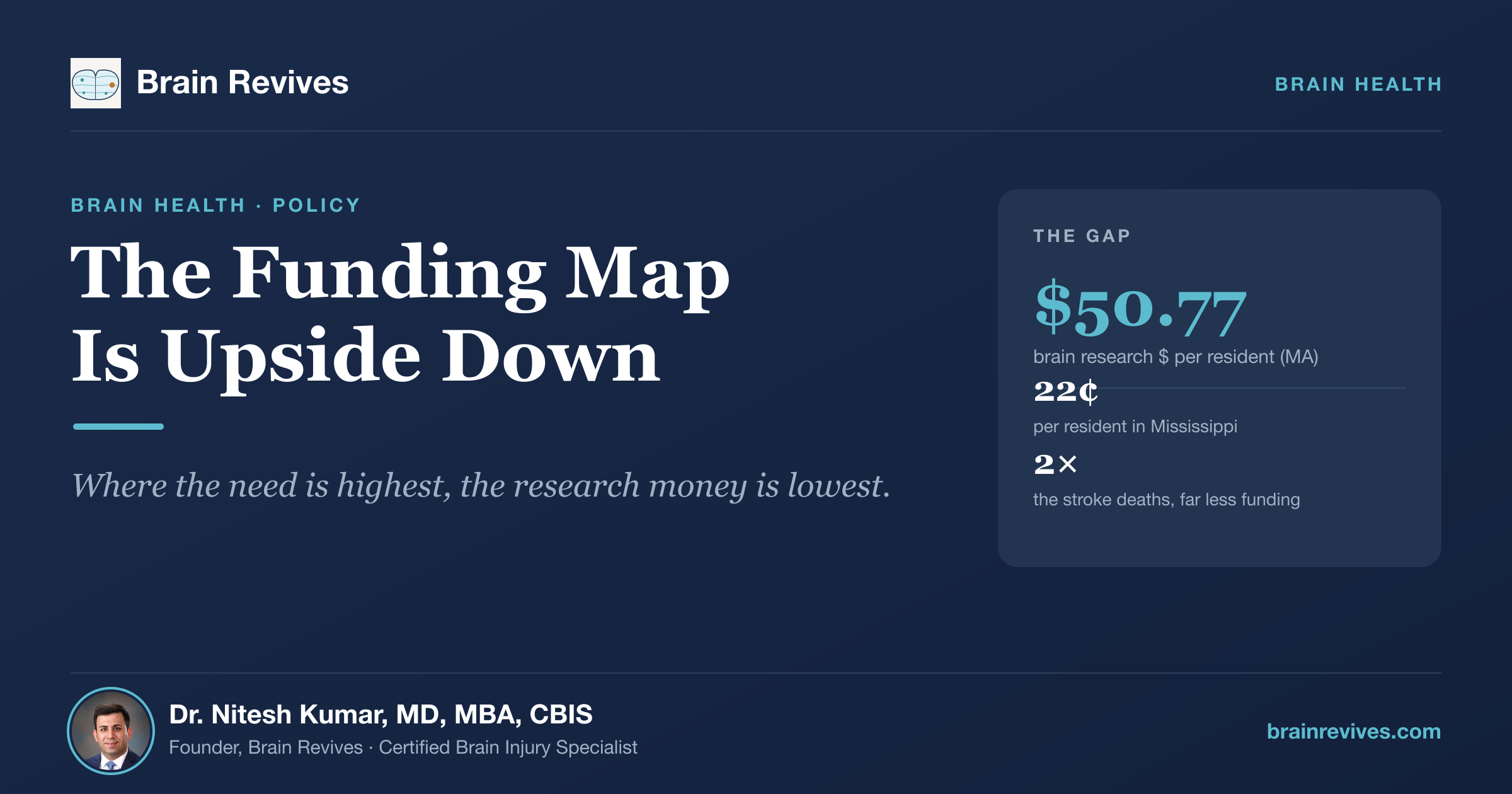
Massachusetts receives $50.77 per resident in federal neuroscience research funding. Mississippi, with more than twice the stroke mortality, receives 22 cents. The fix is not moving the labs. It is moving the knowledge.
I spent this week building an interactive map of brain health in America, state by state. Stroke mortality. TBI hospitalizations. Alzheimer’s prevalence. Cognitive decline. Then I added one more layer: where federal neuroscience research dollars actually go.
Put the two maps side by side and they are nearly photographic negatives of each other.
The numbers nobody puts side by side
In fiscal year 2025, the National Institute of Neurological Disorders and Stroke awarded roughly $2.55 billion across 4,857 grants. Per resident, here is how that distributes:
Mississippi has more than double Massachusetts' stroke mortality, and about 1/230th of its per-resident brain-research funding.
- Massachusetts: $50.77 per person. Stroke mortality among the lowest in the nation.
- Mississippi: $0.22 per person. Stroke mortality of 105.3 per 100,000 adults over 35, more than double Massachusetts’ rate. Total NINDS funding for the entire state: about $641,000. Roughly one R01 grant. (Delaware, the highest-mortality state in the latest CDC series, receives 40 cents.)
- West Virginia: $0.30 per person. The highest TBI hospitalization rate in the country, 178 per 100,000, and the highest Alzheimer’s prevalence among adults 65 and older, 14.2 percent.
- Alaska, Hawaii, and South Dakota: zero NINDS awards in FY2025. Not low. Zero. They receive NIH support through other institutes and the IDeA program, but from the nation’s neurological institute specifically, nothing reached them this year.
Eight of the ten states with the highest stroke mortality receive less than a tenth of Massachusetts’ per-resident research funding. The states where brains are most at risk are the states the research engine touches least.
This is not a story about villains
Let me be precise about what these numbers do and do not say, because the lazy version of this argument deserves to lose.
NINDS funds science, and science concentrates where research infrastructure exists. Boston has MGH, Harvard, MIT, and a century of accumulated capability. Peer review rewards that capability, and it should. Nobody serious is proposing we apportion R01 grants by ZIP code, and redistributing labs to Tupelo would be neither feasible nor useful. The research engine is working as designed.
That is exactly the problem. The system has no second engine.
We have built a world-class machine for discovering how the brain heals, and almost no machine for delivering what we discover to the people doing the healing. The knowledge generated on those Boston campuses, structured recovery routines, sleep protection after brain injury, caregiver training, fall prevention in neurological disease, stroke risk modification, is not sitting behind a paywall of physics. It travels at essentially zero marginal cost. And yet a stroke survivor discharged in Jackson, Mississippi goes home with a thin discharge packet and a follow-up appointment weeks away, while her counterpart in Boston is enrolled in a structured follow-up program built on three decades of recovery science.
Same brain. Same biology. Same evidence base. Different ZIP code, different odds.What the gap actually costs
The states at the bottom of the funding map are, not coincidentally, the states at the bottom of the household income tables. Poverty, distance from academic centers, thinner hospital margins, and fewer rehabilitation resources stack on top of each other. The result is a quiet rule of American medicine that nobody defends out loud but everybody tolerates in practice: socioeconomic status predicts recovery in ways medicine has stopped questioning.
It should not. A person’s income, or their state’s research endowment, should never be a variable in whether they survive a stroke or recover from a brain injury. We accept that principle instantly when it is said plainly. Then we operate a system that violates it every day.
And the violation is measurably lethal. An estimated 80 percent of strokes are preventable through risk factor management that costs almost nothing to teach. Falls are the leading mechanism of TBI hospitalization and death in older adults, and fall risk in neurological disease is modifiable with structured education. The first 30 to 90 days after discharge, the window where families are most alone, is precisely the window where low-cost, evidence-based support changes trajectories. None of this requires a research university. All of it requires intent.
The part we can fix this quarter
Here is the reframe I want hospital leaders to sit with: your state’s position on the funding map is not your constraint. Your discharge process is.
A hospital in Mississippi or West Virginia cannot become a top-ten NIH recipient. It can absolutely ensure that every stroke and TBI patient leaves with a structured recovery plan, a trained caregiver, and scheduled education through the most dangerous 90 days of their recovery. That is not research. That is translation. It is the cheapest high-yield intervention in neurology, and it is sitting on the table.
This is the gap I built my work around, on both sides of the hospital door:
For health systems: at A3HCS, I help hospitals close exactly this translation gap, the care transitions and discharge processes that determine what patients actually receive. If your hospital sits in a high-burden, low-funding state, you are not waiting on Washington.
For patients and families: at Brain Revives, I deliver physician-led recovery education for the post-discharge window the system abandons. It works anywhere there is an internet connection, which is rather the point.
The research map will stay concentrated, and that is fine. The knowledge map is the one we are allowed to redraw, starting now. No congressional appropriation required.
The brain you save was never going to be saved by a lab. It was going to be saved by what happened after discharge.
Explore the interactive state-by-state map, including the Research $ layer, at brainrevives.com/brain-map.
Brain Revives provides educational recovery support and is not a substitute for medical care, diagnosis, treatment, therapy, emergency care, or physician-directed advice. If this is an emergency, call 911 or go to the nearest emergency department.